Russian Houses across Europe: How other countries have responded
Germany continues to allow the Russian House in Berlin to operate. Elsewhere in Europe, governments have closed Russian cultural centres, suspended their activities or curtailed official representations. Yet the picture is more complicated than Rossotrudnichestvo’s official presentation suggests. Some countries never had a public-facing Russian House; in others, earlier structures quietly disappeared, or Russia continued its outreach through embassies, associations, schools and hubs in neighbouring countries. These country files examine which tools other governments have used — and what those choices imply for Germany’s handling of the Russian House in Berlin.
Country files at a glance
All 26 EU Member States with a country file of their own, plus the Republic of Moldova, are now covered; Germany is not treated as a country file because it is the subject of this press kit. For individual states, treaty and register details are explicitly marked as open. The key findings are visible before each panel is opened. Select a country for the fuller summary; the linked country files provide the complete timeline, legal basis, official statements and source list.
 Austria
Active part of the embassy
State cooperation suspended
Article 15 of the cultural agreement expressly names the Vienna centre.
Austria
Active part of the embassy
State cooperation suspended
Article 15 of the cultural agreement expressly names the Vienna centre.
Article 15 of the 1998 cultural agreement expressly names the Vienna centre as a cultural centre attached to the Russian embassy. In 2023 the foreign ministry classified it as a notified part of the embassy and applied the Vienna Convention.
Since February 2022 all bilateral state cultural activities have been suspended – a suspension of cooperation, not a closure. The institute was holding events and teaching into the summer of 2026.
 Belgium
Official site active
Legal status open
Belgium expelled 21 Russian diplomats – the house in Brussels stayed open.
Belgium
Official site active
Legal status open
Belgium expelled 21 Russian diplomats – the house in Brussels stayed open.
By its own account the Russian House in Brussels has been attached to the Russian embassy since the mid-1990s. A Belgian status instrument, a specific centre treaty and any enforcement relating to the house are not documented in public sources.
On 29 March 2022 Belgium expelled 21 Russian embassy and consular staff and implements the EU sanctions. Both measures are documented; neither is attributed to the house. Events were still taking place there in April 2026.
 Bulgaria
Official site active
Tax proceedings pending
Sofia acknowledged the potential sanctions implications in 2024; in 2026 a tax audit still had not begun.
Bulgaria
Official site active
Tax proceedings pending
Sofia acknowledged the potential sanctions implications in 2024; in 2026 a tax audit still had not begun.
The Russian Cultural and Information Centre in Sofia remains active. Bulgaria explicitly acknowledged the centre’s potential sanctions exposure in 2024 but did not implement corresponding measures. In 2026 the tax authority found taxable economic activity without the corresponding tax returns and tax payments.
A Sega investigation also documented numerous visits by municipal schools and kindergartens after 24 February 2022. The basement additionally houses the third-party-operated “Fotonika” fighter-aircraft simulator, with offers explicitly available from the age of six.
 Croatia
No official house established
Tax proceedings pending
Former structure no longer traceable
The planned centre was never implemented by treaty; a later substitute representation disappeared after 2022.
Croatia
No official house established
Tax proceedings pending
Former structure no longer traceable
The planned centre was never implemented by treaty; a later substitute representation disappeared after 2022.
The general cultural agreement between Croatia and Russia did not establish a centre. A separate agreement on information and cultural centres was envisaged in 2013, but in 2015 it was explicitly recorded as not implemented.
Even so, a Rossotrudnichestvo representation can be documented by 2018 and the public brand “Russian House Zagreb” by 2021. After Croatia drastically reduced the Russian embassy in 2022, regular activity was no longer publicly traceable. Later sources referred to suspension, but no Croatian closure act has been found.
 Cyprus
Active official representation
Continued treaty validity open
Continued presence despite the EU listing; no status agreement findable.
Cyprus
Active official representation
Continued treaty validity open
Continued presence despite the EU listing; no status agreement findable.
The centre in Nicosia has existed since 1978 and is an official Rossotrudnichestvo representation. After the fire of 2023 – for which the police found no evidence of arson – it is documented holding events in 2024 and again in 2026.
A protocol of 2000 describes the 1972 cultural agreement as continuing in force; the notification date required for its entry into force was not found. A separate status agreement for the centre could not be verified.
 Czechia
Financially and operationally restricted
Programmes still active
The property became a sanctions case, while cultural, language and online services continued.
Czechia
Financially and operationally restricted
Programmes still active
The property became a sanctions case, while cultural, language and online services continued.
Czechia treated the building and its commercial use as a sanctions matter. Revenue and economic exploitation were heavily restricted. That did not amount to a political closure of the Russian House.
Events, language courses, the library and online services continued. The general cultural agreement also remained in force despite being terminable. The legal framework explains the present intermediate situation; it did not compel the government to preserve it.
 Denmark
Regular in-person operations ended
Intermittent use reported
A staffing cap ended regular operations in 2023; since 2025 the Russian embassy has reported individual events.
Denmark
Regular in-person operations ended
Intermittent use reported
A staffing cap ended regular operations in 2023; since 2025 the Russian embassy has reported individual events.
Copenhagen hosted an official Russian Centre for Science and Culture. Denmark did not close it through a measure directed specifically at the institution. Instead, in September 2023 it capped the Russian mission as a whole at five diplomats and 20 administrative and technical staff. Regular operations then ceased.
The centre has been absent from Denmark’s diplomatic list since 2024. Russian embassy channels nevertheless began reporting individual events in May 2025 at a venue they continued to call the Russian House or RCSC. That demonstrates intermittent use, not the restoration of the former full-scale Rossotrudnichestvo operation.
 Estonia
No official house established
Partner structures kept distinct
No Rossotrudnichestvo centre evidenced – but three structures easily confused.
Estonia
No official house established
Partner structures kept distinct
No Rossotrudnichestvo centre evidenced – but three structures easily confused.
No official Rossotrudnichestvo centre could be verified for Estonia. The Tallinn diplomatic list of June 2026 names the embassy but no science and culture centre.
Three structures must be kept apart: the municipal Vene Kultuurikeskus of the City of Tallinn, a Russkiy Mir centre at a private language school, and the embassy. Their consolidation in 2025 was a municipal organisational decision.
 Finland
Financially and legally restricted
Institution still active
Accounts were frozen and the property placed under legal attachment, but the institution remained in place.
Finland
Financially and legally restricted
Institution still active
Accounts were frozen and the property placed under legal attachment, but the institution remained in place.
Finland enforced EU sanctions against Rossotrudnichestvo and froze accounts. The Russian House property was seized or placed under legal attachment in connection with Ukrainian compensation claims in the Naftogaz proceedings.
Enforcement was ordered but has not become final because Russia appealed. The institution nevertheless remained organisationally and digitally active. Finland also left the cultural agreement in force, even though it can be terminated with six months’ notice.
 France
Official site active
State cooperation suspended
Paris suspended cooperation but did not terminate the 1992 treaty.
France
Official site active
State cooperation suspended
Paris suspended cooperation but did not terminate the 1992 treaty.
The 1992 intergovernmental agreement reciprocally establishes a French centre in Moscow and a Russian one in Paris and attaches the latter to the embassy. In 2022 France suspended state cooperation in culture, higher education and science.
According to the official sources examined the agreement was not terminated and the Maison russe not closed; it was open in July 2026. A freezing of accounts in late 2024 was asserted only in Russian reporting and is not officially confirmed.
 Greece
Official site active
Cultural cooperation suspended
The culture minister made it explicit: suspension, not annulment.
Greece
Official site active
Cultural cooperation suspended
The culture minister made it explicit: suspension, not annulment.
The agreement signed in 2001 and ratified in 2005 gives both centres legal capacity and places them under host-state law. International entry into force remained open because the last notification required under Article 16 was not found.
From February 2022 the culture ministry suspended cooperation with Russian cultural organisations. According to reports of her answer in parliament the minister stressed that suspension was not annulment. State language examinations were held at the house in July 2026.
 Hungary
Official site active
Ownership and treaty status open
Budapest continues to operate; no measure relating to the house was found.
Hungary
Official site active
Ownership and treaty status open
Budapest continues to operate; no measure relating to the house was found.
The Budapest house is an institution embedded in the Russian embassy structure, not a mere partner organisation. The 1993 agreement recognises the centres but refers their support to a separate agreement whose text was not found.
No Hungarian closure, no suspension of the cultural agreement and no asset enforcement specific to the centre were found. A heritage database describes the building as Russian state property – without a land register extract that remains a secondary statement.
 Ireland
No official site established
Partner and diaspora network active
Negotiations in 2010 did not demonstrably produce a centre.
Ireland
No official site established
Partner and diaspora network active
Negotiations in 2010 did not demonstrably produce a centre.
No official Rossotrudnichestvo office or formal Russkiy Mir centre could be evidenced for Ireland. What is documented is that Trinity College announced advanced negotiations on Ireland’s first Russian cultural centre in 2010 – which is not a conclusion.
Visible instead are private cultural organisations and a compatriots network close to the embassy. The “Matryoshka” centre appearing in foundation reports in 2026 is evidence of activity but is not listed as a representation in the formal catalogue.
 Italy
Official site active
Treaty status open
The house in Rome has operated since 2011 – its treaty status is unresolved.
Italy
Official site active
Treaty status open
The house in Rome has operated since 2011 – its treaty status is unresolved.
The Russian House in Rome is an official Rossotrudnichestvo institution and has operated in a historic palazzo since November 2011. The classification of the building as private property rests on the operator’s own account and was not independently verified.
Two questions of entry into force remain open in law: for the general 1998 agreement the last notification is missing, and for the specific centre agreement any Italian evidence of ratification or entry into force.
 Latvia
Operations ended
Property transferred by statute
Moscow House was a city representation – not a Rossotrudnichestvo centre.
Latvia
Operations ended
Property transferred by statute
Moscow House was a city representation – not a Rossotrudnichestvo centre.
According to the State Security Service, Moscow House in Riga was the representation of a state-municipal Moscow company whose sole shareholder was the Moscow property authority – not a Rossotrudnichestvo mission.
Since 2022 it has passed through four stages that must be kept apart: frozen economic resource, subject of criminal proceedings, transferred unencumbered to the state by special law, and put up for sale. By the end of September 2025 no buyer had been found.
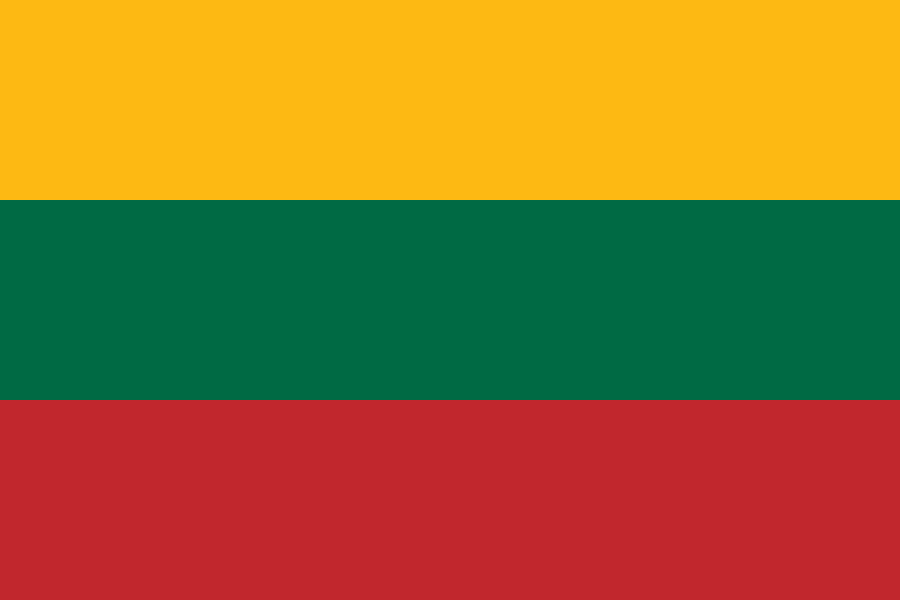 Lithuania
Never regularly opened
Demolition proceedings open
Never opened – and still not demolished on 1 August 2026.
Lithuania
Never regularly opened
Demolition proceedings open
Never opened – and still not demolished on 1 August 2026.
Moscow House in Vilnius never entered regular operation. It must therefore be described neither as a Russian House closed after February 2022 nor as a former Rossotrudnichestvo presence. The building permit became definitively invalid in 2017.
The demolition is legally ordered but not carried out: in July 2026 a court halted the planned transfer to the city; on 1 August 2026 signatures and judicial confirmation of a privately financed arrangement were missing.
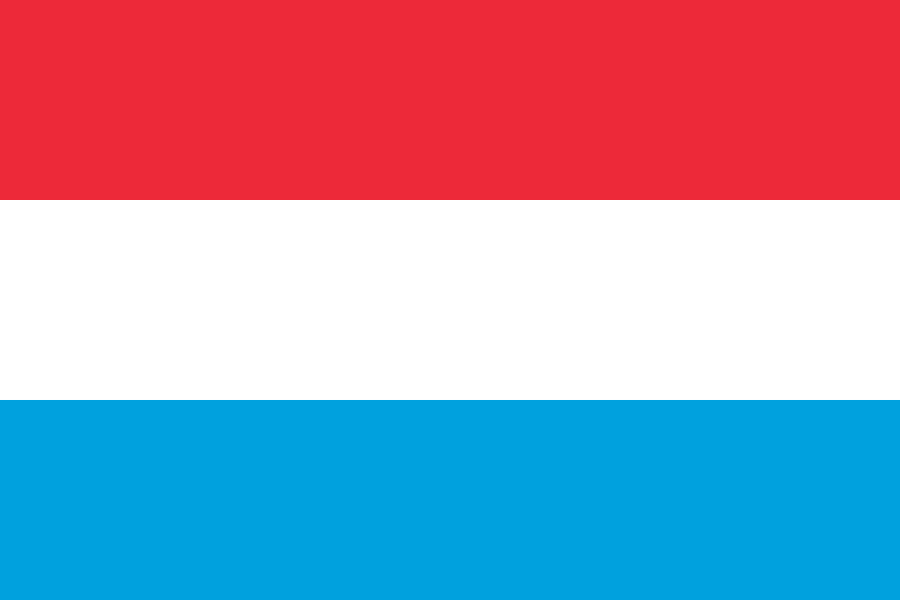 Luxembourg
Official site active
Status agreement not public
The 2010 status agreement is documented – its wording is not findable.
Luxembourg
Official site active
Status agreement not public
The 2010 status agreement is documented – its wording is not findable.
Two legal acts underpin the centre: the 1993 general agreement approved in 1996, with an express termination clause, and a special agreement of 16 March 2010 on status and operation which, according to the foreign ministry’s annual report, entered into force immediately.
Luxembourg enforces sanctions robustly and expelled a diplomat in 2022; neither the expulsion nor the published freezing figures are attributed to the house. Several events took place there in April 2026.
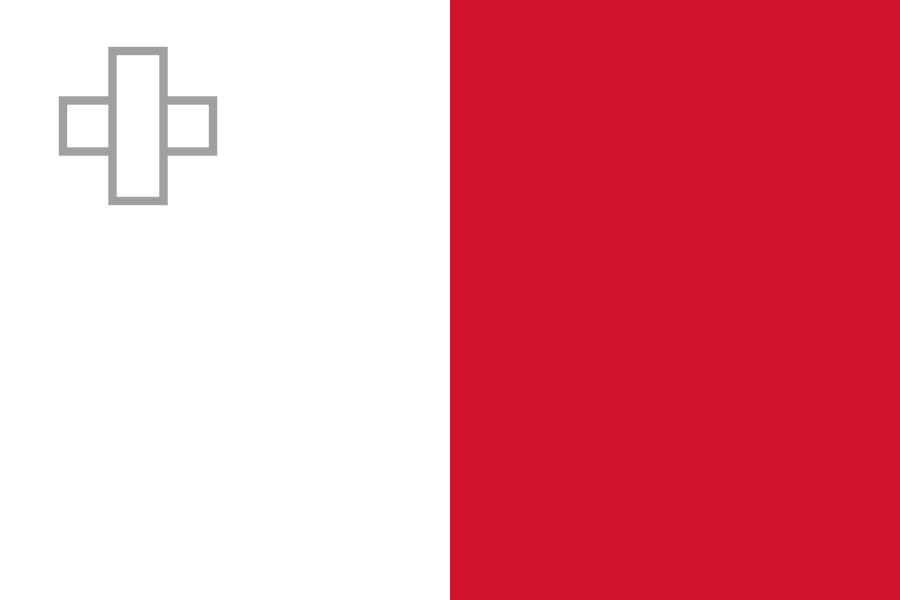 Malta
Official site active
Temporarily closed in 2022
The 2022 closure was for protection – not by state order.
Malta
Official site active
Temporarily closed in 2022
The 2022 closure was for protection – not by state order.
The centre in Valletta has existed since 1990. The legal trail reaches back to an exchange of notes of 1987 but is largely documented through Russian government decisions approving drafts; signed final texts and their entry into force were not found.
From 3 March 2022 the centre closed temporarily on its own initiative after threats and police intervention. There is no evidence of a state closure order. Events from 2024 to 2026 document resumed on-site operations.
 Netherlands
Former representation disappeared
Partner network active
No current house, but a decentralised network spanning the embassy, associations, schools and Brussels.
Netherlands
Former representation disappeared
Partner network active
No current house, but a decentralised network spanning the embassy, associations, schools and Brussels.
There is no official Russian House in the Netherlands today. An official Rossotrudnichestvo country representation can nevertheless be documented in 2013 and 2014. It apparently had no dedicated public cultural building and had disappeared by 2017 at the latest, well before the full-scale invasion.
Its functions survived in decentralised form through the Russian embassy, the KCOPC/KSORS compatriot council, schools, cultural associations, honorary consulates, the University of Groningen and the Russian House in Brussels. Cooperation by local organisations with Rossotrudnichestvo does not by itself prove financing, ownership or command.
 Poland
In-person operations suspended
Digital structure remains active
Poland did not close it: Rossotrudnichestvo suspended the Warsaw site’s in-person operations in 2026.
Poland
In-person operations suspended
Digital structure remains active
Poland did not close it: Rossotrudnichestvo suspended the Warsaw site’s in-person operations in 2026.
Warsaw hosted an official Russian centre. Poland recognised its propaganda and disinformation role but refrained from ordering a state closure, partly because of the Polish Institute in Moscow and the principle of reciprocity.
In February 2026, Rossotrudnichestvo itself suspended in-person operations and shifted responsibilities to Budapest. Digital channels remained active. No documented causal link has been found between a Polish government measure and the Russian withdrawal, and the underlying agreement was not terminated.
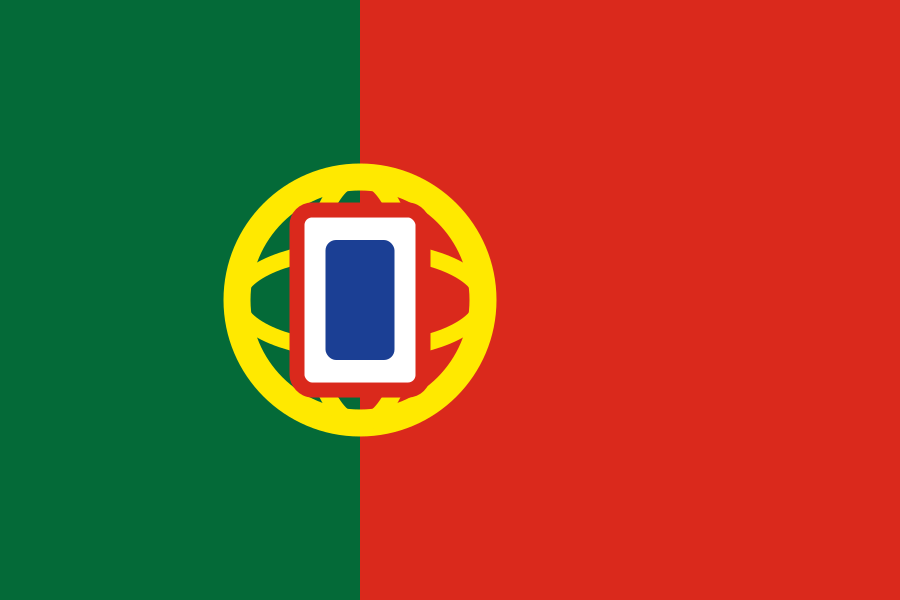 Portugal
Embassy representation evidenced
No separate house established
A representative inside the embassy rather than a separate centre.
Portugal
Embassy representation evidenced
No separate house established
A representative inside the embassy rather than a separate centre.
For Portugal the official Rossotrudnichestvo page names no operation identified as a separate legal person, but a representative on the staff of the Russian embassy – while listing a Lisbon contact address of its own and using the “Russian House” brand.
On 5 April 2022 Portugal expelled ten mission staff. The representative being among them is conceivable but, without a list of names, speculation. Whether regular public operations take place at the contact office remained open.
 Romania
Operations ended
Residual legal status unclear
Bucharest suspended the centre’s operations in 2023; some formal entries remained.
Romania
Operations ended
Residual legal status unclear
Bucharest suspended the centre’s operations in 2023; some formal entries remained.
Bucharest hosted a formally established Russian Centre for Science and Culture under a bilateral agreement signed in 2013. On 21 February 2023, Romania’s Foreign Ministry informed the Russian ambassador that the centre’s activities were being suspended. Operations had to end by 20 August 2023.
The government explicitly cited propaganda, disinformation, distorted accounts of historical facts and attempts to justify Russian war crimes. Bucharest is absent from Rossotrudnichestvo’s current map, although continuing registry entries mean that the residual formal status has not been clarified in every detail.
 Slovakia
Official site active
Legal form and treaty position open
The 2022 cooperation halt was lifted again in January 2024.
Slovakia
Official site active
Legal form and treaty position open
The 2022 cooperation halt was lifted again in January 2024.
Bratislava has an official Rossotrudnichestvo representation. The state transparency portal lists it with name and address but states no legal form; no signed centre agreement was found – only a Russian draft of 1996.
In March 2022 the culture ministry prohibited its own organisations from cooperating and lifted that prohibition in January 2024. On-site events in 2025 and 2026 evidence continuing operations.
 Slovenia
Physically closed
End of treaty open
Terminated and closed – the immediate legal effect remains open.
Slovenia
Physically closed
End of treaty open
Terminated and closed – the immediate legal effect remains open.
On 22 March 2022 Slovenia initiated termination of the 2011 agreement; according to the foreign ministry the note was delivered on 1 April. The centre in Ljubljana closed on 8 April 2022, a week before the deadline.
The note itself, any Russian reply and an official announcement of the date of termination were not found. On a purely ordinary application of Article 17 the next period would end on 19 September 2026.
 Spain
Official site active
Extent of on-site operations open
The most detailed treaty – premises expressly not inviolable.
Spain
Official site active
Extent of on-site operations open
The most detailed treaty – premises expressly not inviolable.
The 2001 agreement reciprocally governs the Instituto Cervantes in Moscow and the centre in Madrid. It confers the rights of legal persons, places the centres under host-state law and expressly excludes diplomatic inviolability of the premises.
In April 2022 Spain expelled some 25 Russian diplomats and embassy staff; no attribution to the house was found. The house remained active, though no dated on-site event could be evidenced for 2026.
 Sweden
No official house established
Former representation disappeared
A control case: “not found” is something other than “does not exist”.
Sweden
No official house established
Former representation disappeared
A control case: “not found” is something other than “does not exist”.
The Stockholm diplomatic list of February 2026 names the embassy, the consular section and the trade mission, but no Russian cultural centre. Because it expressly includes cultural institutes of other states, this strengthens the negative finding – without proving non-existence.
All that is documented is a historic “cabinet for Russian language and literature” in Gothenburg, opened with a district administration and the consulate general. Its year of opening could not be verified, nor could any present operation.
 Republic of Moldova · non-EU
Operations ended
Embassy structure remains active
Moldova terminated the agreement in time; the Russian House closed on 4 July 2026.
Republic of Moldova · non-EU
Operations ended
Embassy structure remains active
Moldova terminated the agreement in time; the Russian House closed on 4 July 2026.
The Russian House in Chișinău operated under a 1998 agreement on cultural centres. Article 17 provided for automatic five-year renewals unless either side gave written notice at least six months before the end of the current term. After further Russian drone incursions into Moldovan airspace, the government began the termination procedure in 2025; Russia was formally notified on 3 December 2025.
The agreement expired on 4 July 2026, and the official Russian House ceased operating the same day. Rossotrudnichestvo nevertheless retained a representative inside the Russian embassy, where education quotas and other so-called humanitarian programmes are expected to continue.
Russia’s own picture of its European network
Rossotrudnichestvo publishes a map of its Russian Houses and overseas representations on its own website. It shows how the agency presents its presence in Europe — and provides the starting point for comparing that presentation with the structures that can actually be documented.
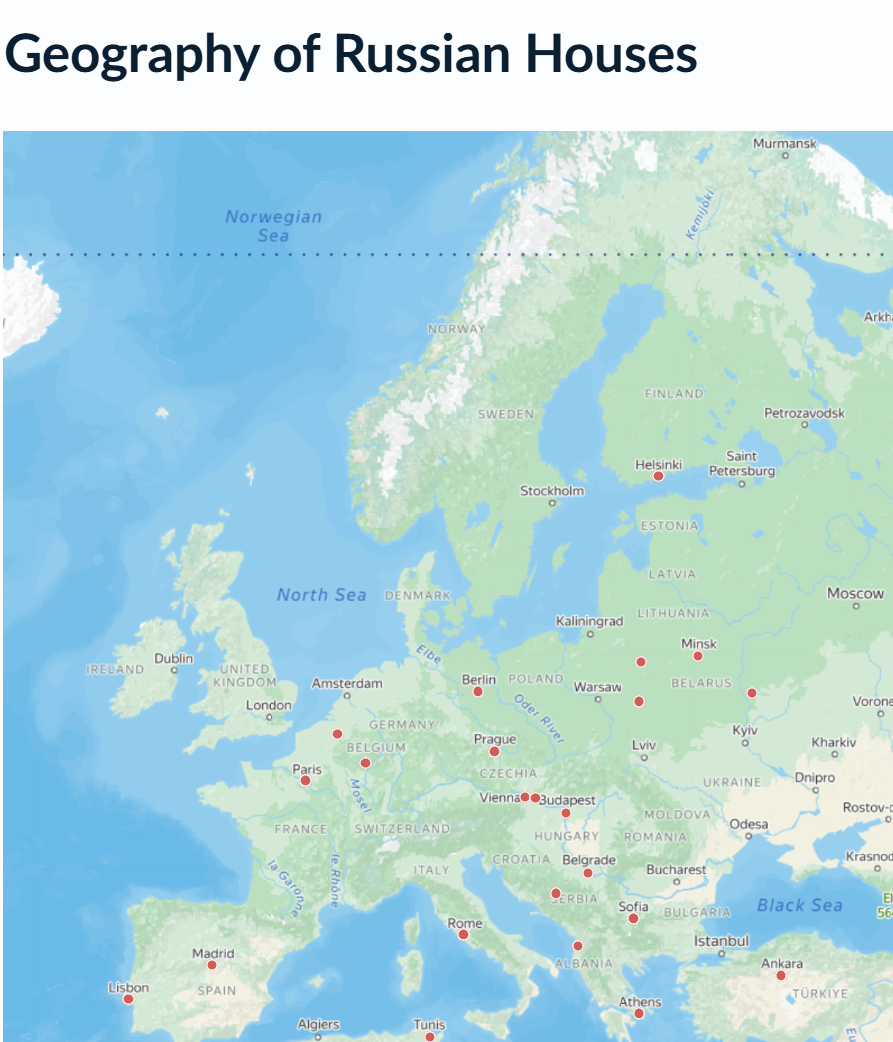
Russia’s official map of Russian Houses — fact-checked
The red dots are meant to identify cities where Rossotrudnichestvo says it operates a Russian House or overseas representation. The map is not, however, a complete or consistently reliable directory.
Comparing it with the agency’s own country pages already reveals discrepancies. Warsaw, for example, has no red dot, even though Rossotrudnichestvo continues to maintain a dedicated website for the Russian House there, complete with an address, contact details and programme areas.
A missing dot therefore does not prove that no Russian structure exists in a country. A centre may have been closed; an earlier representation may have disappeared; or Russia may continue its work through an embassy, schools, associations, partner organisations or a Russian House in a neighbouring country. Conversely, a dot tells us little about the site’s legal form, size, diplomatic status or current level of activity.
That is why the country files go beyond the current location list. They distinguish between official Russian Houses, Rossotrudnichestvo representations, embassy-based structures, Russkiy Mir centres, “compatriot” networks and local partner organisations.
The legal baseline since 2022
The European Union added Rossotrudnichestvo to its sanctions list on 21 July 2022. That did not amount to an automatic EU-wide closure order. Whether a centre could keep operating also depended on property rights, diplomatic status, bilateral agreements and the measures taken by each host state.
The status labels on this page therefore describe what can be documented on the ground — not the label Russia gives an organisation.
The comparison now shows something else as well: a terminable agreement need not become permanent
The 26 EU Member States examined used very different tools: suspending operations, blocking financial flows, sanctioning property and operators, reducing diplomatic structures, halting a never-opened project under building law, transferring a property by special statute, or allowing a weakly rooted substitute arrangement to fade. Just as often, cooperation was suspended while the house carried on. The Republic of Moldova adds the first European non-EU case in which the treaty-based termination process was carried through in full: the agreement expired and the official Russian House closed.
Moldova also shows the limits of closure. Some education and influence functions can migrate into an embassy or partner structures. The decisive comparison therefore remains broader than “Who closed?” It is: Which legal and political options existed, which were actually used, and which substitute channels remained open?
More country files to follow
The research is ongoing. Country files are reviewed for location history, legal basis, government measures and sources and updated as new findings emerge. Open evidentiary questions – on entry into force, legal entities, ownership, accounts and accreditations – are explicitly marked as open in the country files.