Two Institutions, One Treaty, a Difference in Kind
From the outside, the Goethe-Institut and the Russian House appear similar. Structurally, they are entirely different. The Goethe-Institut is a legally independent cultural mediator. The Russian House is the Berlin branch of a Russian federal agency – and part of an integrated architecture of state influence. For this reason, a simple language course cannot be evaluated in the same institutional context. The alleged symmetry between the two institutions is the cornerstone of German treaty logic – and it is false. Here is the structural breakdown.
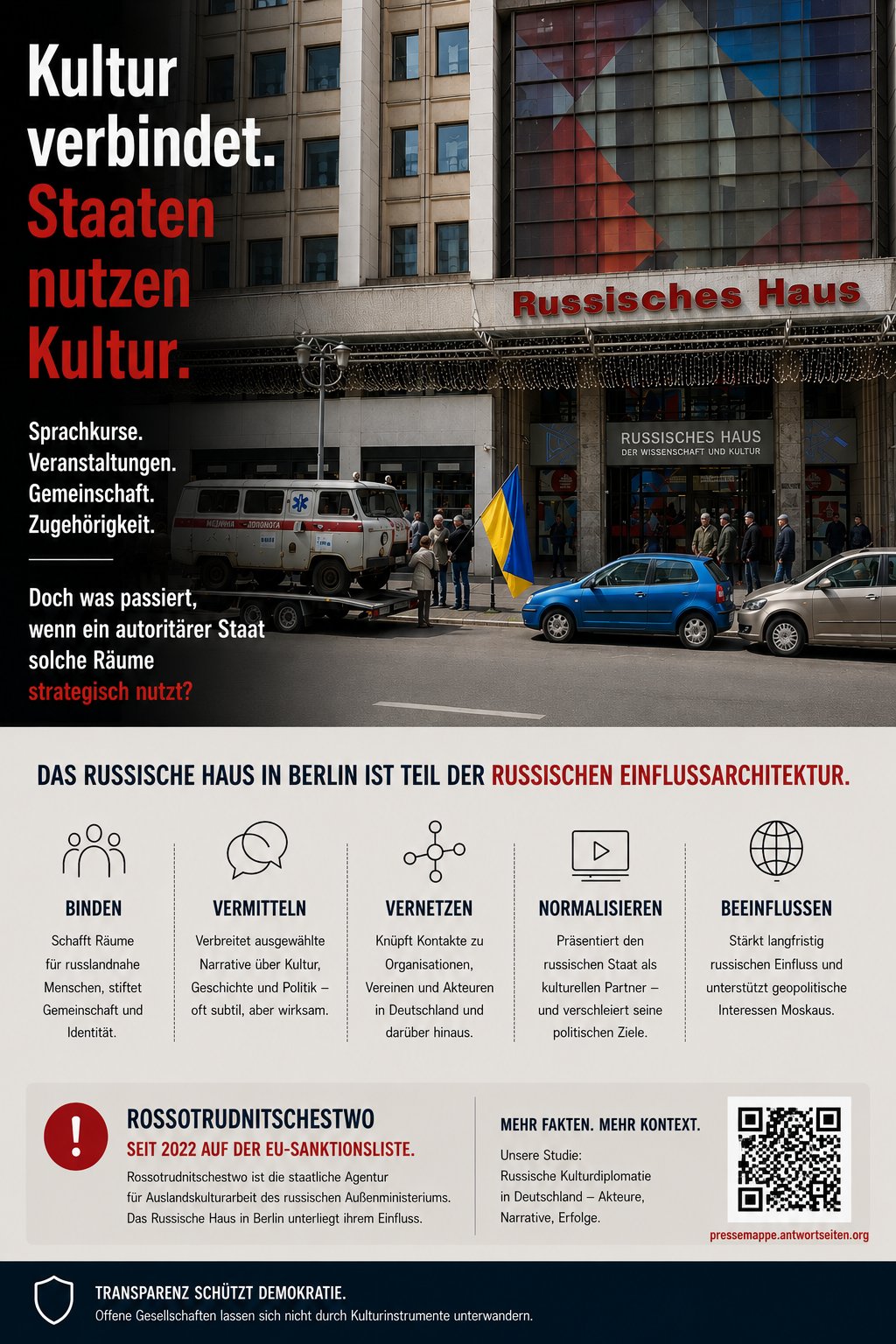
While Appearing as Language Courses, Programs Rest in a Broader Architecture
The Russian House is the Berlin representation of Rossotrudnichestvo, the federal agency of the Russian Ministry of Foreign Affairs tasked with “compatriot” policy and humanitarian cooperation. Operating alongside – neither above nor below – is the Russkiy Mir Foundation, which, while formally a non-governmental organization, is actually funded by the Russian state budget and controlled by executive authorities, maintaining its own centers and offices in six German federal states. This network is further expanded by embassies, “compatriot” structures, and partner organizations. A study by the Ukrainian Institute (2024) describes this system as rather hierarchical but at the same time highly dispersed, explicitly identifying the Russian House and Russkiy Mir as the two pivotal, parallel institutions of Russian cultural diplomacy in Germany.
An individual language course may not contain overt propaganda. However, the decisive factors are who operates the infrastructure, the political mandates assigned to that institution, and the network in which it is embedded.
What Distinguishes the Russian House from the Goethe-Institut?
Four structural differences. Tap the headings below to expand details.
Legal Form and Chain of Command
Official Mandate
Programming and Narratives Since February 24, 2022
Accountability and Immunity
Program Analysis: 179 Events, One Verdict
Data gathered from April to May 2026 via russisches-haus.de and goethe.de. All events at both institutions were recorded and categorized by format and narrative alignment.
The distinction is not one of degree, but of kind. For the Goethe-Institut, culture is the objective. For the Russian House, culture is the instrument.
What Security Risks Does the Russian House Pose?
Four documented risk areas. Tap the headings below to expand details.
1. Active Propaganda Production
In 2022, the in-house cinema screened an RT propaganda film that equated WWII atrocities with modern Ukraine – depicting Ukrainians as Nazis and Russia as the liberator. The on-site bookstore carries works by Russian war ideologues and right-wing extremists, alongside toys celebrating the military campaign.
Our program analysis indicates that WWII narratives, peace rhetoric, and the use of Pushkin as an imperial symbol are not accidental, but represent the coordinated output of a sanctioned federal agency.
2. Support for Pro-Russian Networks
According to Reuters, the Russian House funded flight tickets for a former Russian air force officer and his partner, who co-organized pro-Russian motorcades in Germany, enabling them to travel to a Kremlin-associated event in Moscow. Rossotrudnichestvo has also reportedly helped coordinate pro-Russian demonstrations within Germany.
Language courses, children’s clubs, and conversation groups build a community infrastructure that can be politically mobilized – a pattern identified by the BfV (Federal Office for the Protection of the Constitution) as standard for Russian influence operations.
3. Apparent Sanctions Violations – Unresolved
Rossotrudnichestvo has been on the EU sanctions list since July 2022. The legal consequences require the freezing of assets and a prohibition on making funds or economic resources available. Despite this, events run daily, ticket sales continue, and media reports point to unresolved questions surrounding commercial rentals.
The Berlin Public Prosecutor’s Office closed investigations into potential violations of the Foreign Trade and Payments Act, citing diplomatic immunity for the leadership. Concurrently, under a 2013 property agreement, Germany covers the property tax for the building, which amounts to approximately 70,000 euros in the 2026 federal budget.
4. Intelligence Context
The Berlin Senate has officially confirmed that the boundaries between cultural public relations and intelligence-style gathering of protected information remain highly fluid. The BfV notes that Berlin is a primary target for Russian intelligence services in Europe, leveraging a vast network of local contacts.
Russian Post reports that it maintains its first official foreign branch office inside the Berlin facility. Trial shipments have revealed simplified customs documentation, which limits effective cargo screening.