19. April 1993
Agreement on culture, education and science
Bulgaria and Russia conclude the Agreement on Cooperation in Culture, Education and Science. Later intergovernmental cooperation programmes are based on it.
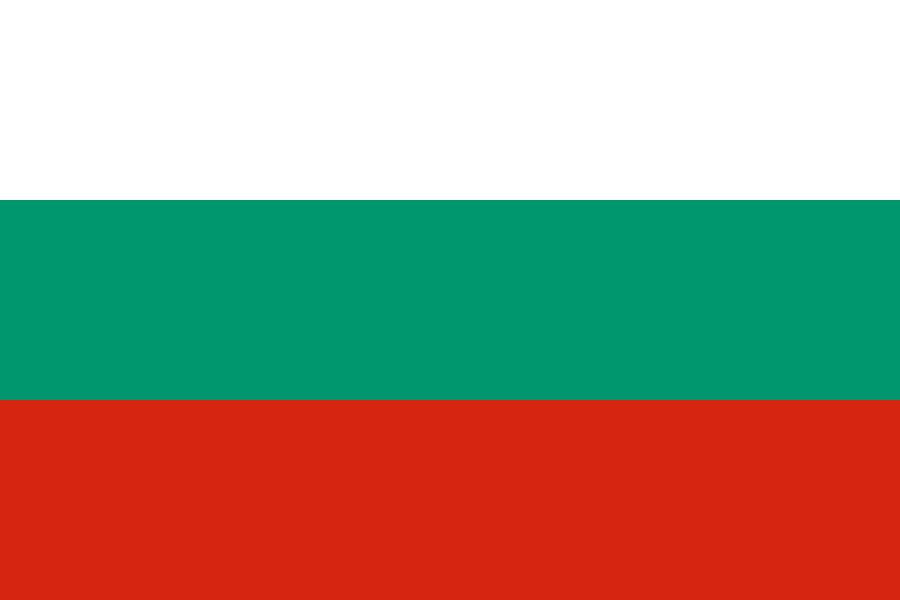 Europe dossier · Country file: Bulgaria
The Russian Cultural and Information Centre at 34 Shipka Street is an official overseas representation of Rossotrudnichestvo. Bulgaria explicitly acknowledged the centre’s potential sanctions exposure in 2024, but no such measure was implemented. In 2026 the tax authority found taxable economic activity without the corresponding tax returns; the centre nevertheless remained open.
Bulgaria is a case of announced but unimplemented measures. The government acknowledged the centre’s potential sanctions exposure in 2024. In 2026 the tax authority found taxable economic activity without the corresponding tax returns and tax payments. The centre remains active.
| Centre | Russian Cultural and Information Centre (RCIC), Sofia |
|---|---|
| Operator | Rossotrudnichestvo, a federal agency subordinate to the Russian Foreign Ministry |
| Location | 34 Shipka Street, Sofia |
| Legal basis | Agreement on Cooperation in Culture, Education and Science of 19 April 1993; individual treaty details remain to be verified |
| Status | Offizieller Standort weiterhin aktiv; mögliche Sanktionsmaßnahmen nicht vollzogen; Tax proceedings pending |
| Notable feature | Documented work with municipal schools and kindergartens; the building also houses the third-party-operated “Fotonika” fighter-aircraft simulator |
Bulgaria and Russia conclude the Agreement on Cooperation in Culture, Education and Science. Later intergovernmental cooperation programmes are based on it.
The “Fotonika” simulator is presented at the Russian Cultural and Information Centre during a Russian youth festival for scientific and technical creativity. Later listings name the Su-33, Su-25T, MiG-29 and F-16 and include air combat and attacks on ground targets; vouchers are explicitly offered from the age of six.
A screening of the Russian film “Azovstal” prompts protests and a petition calling for the centre’s closure. More than 3,500 signatures are collected in the first four days.
Then Deputy Prime Minister and Foreign Minister Mariya Gabriel tells parliament that the centre’s accounts could be frozen and that her ministry would support such a step. At the same time, she points to unclear domestic responsibilities for sanctions enforcement.
Sega journalist Doroteya Dachkova documents numerous visits by municipal schools and kindergartens after 24 February 2022 following a freedom-of-information request. One school reports six visits involving 449 children from 19 classes, another 134 third-grade pupils, and a third an event attended by 300 pupils.
The National Revenue Agency finds that the centre carries out taxable economic activity but has filed no annual tax returns and paid no corresponding taxes. The inspection ends on 20 March 2026; an audit for 2021–2025 is ordered in April. By early August it has still not begun.
Cultural cooperation is based on the agreement of 19 April 1993. Later bilateral cooperation programmes rely on it. Its duration and termination mechanism are still being reviewed for this country file.
Rossotrudnichestvo has been on the EU sanctions list since 21 July 2022. In 2024 the Bulgarian government explicitly acknowledged the centre’s potential sanctions exposure; no corresponding measure has yet been implemented.
The Bulgarian tax authority treats the centre as a Sofia-based legal entity carrying out taxable economic activity. The audit ordered in 2026 covers the years 2021–2025.
It remains unclear whether a separate agreement specifically governing the centre exists alongside the general 1993 agreement. Ownership of the property at 34 Shipka Street also remains to be verified.
The Sega investigation shows that the centre’s contacts with schools and kindergartens were not limited to isolated private visits. Documented activities include class visits, recitation competitions, a historical quiz and other events after the start of Russia’s full-scale invasion.
Velina Todorova, Vice-Chair of the UN Committee on the Rights of the Child, did not regard Russian-language teaching and practical language use as inherently problematic. In view of Russia’s war of aggression, however, participation by children in events organised and financed by the centre should, she said, be carefully reassessed and monitored.
The centre also rents space to third parties. In the basement, a Bulgarian operator runs the “Fotonika” fighter-aircraft simulator. Listings include aerobatics, air combat and attacks on ground targets; one voucher is explicitly valid from the age of six. The device is not owned by Rossotrudnichestvo but is located inside the cultural centre operated by the sanctioned agency.
Bulgaria presents a different pattern from Romania or Moldova. The political and sanctions problem was recognised but has so far led neither to closure nor to visible enforcement against the centre. Instead, a tax proceeding developed in 2026 and still had not begun months after it was ordered.